Food safety incidents have the potential to reshape equipment specifications long after an individual contamination event has passed. Concerns involving pathogens, toxins, and cross-contamination have pushed feed producers to examine how machinery affects hygiene, inspection, and process control. Within this environment, animal food machine design is increasingly evaluated not only by capacity and energy consumption, but also by cleanability, material selection, accessibility, and contamination control. FAMSUN’s aquafeed processing technologies illustrate how equipment functionality aligns with different feed formats and production requirements.
Why Feed Safety Incidents Affect Equipment Design
Feed safety problems rarely originate from one isolated factor. Raw materials may introduce microorganisms or mycotoxins, while moisture, temperature, storage conditions, and process residues can influence how hazards move through a production line. Equipment design becomes part of a wider preventive strategy.
Listeria and Salmonella receive particular attention because microbial contamination can spread through contact surfaces, residual material, personnel movement, and poorly managed production areas. Even after the original source has been removed, inaccessible residues may create opportunities for recurring contamination.
Mycotoxins present a different challenge. Unlike microorganisms, many toxins are associated with contaminated grains and other agricultural commodities before they enter the mill. Equipment cannot solve the problem by itself, but process controls, ingredient segregation, cleaning practices, and appropriate monitoring can reduce opportunities for contaminated material to affect subsequent batches.
Hygienic Design Becomes A Core Requirement
Smooth internal surfaces can make cleaning more practical by reducing locations where powder and moisture accumulate. Crevices, unnecessary joints, dead zones, and poorly positioned components may create difficult-to-inspect areas, particularly around transfer points and mixing chambers.
Accessibility matters just as much. Operators need practical access to inspection and cleaning areas without excessive dismantling. Such considerations become especially important when production schedules are tight and sanitation procedures must be performed between different formulas or ingredient groups.
Material selection also deserves attention. Surfaces exposed to feed ingredients, cleaning agents, heat, or moisture should be evaluated according to the operating environment. Corrosion, surface degradation, and damaged finishes can create additional maintenance concerns while making sanitation more difficult.
Extrusion And Microbial Risk Management
Thermal processing can play an important role in managing microbial risks in certain feed applications. Extrusion combines mechanical energy, moisture, pressure, and temperature, creating process conditions that can reduce microbial loads when properly controlled and validated.
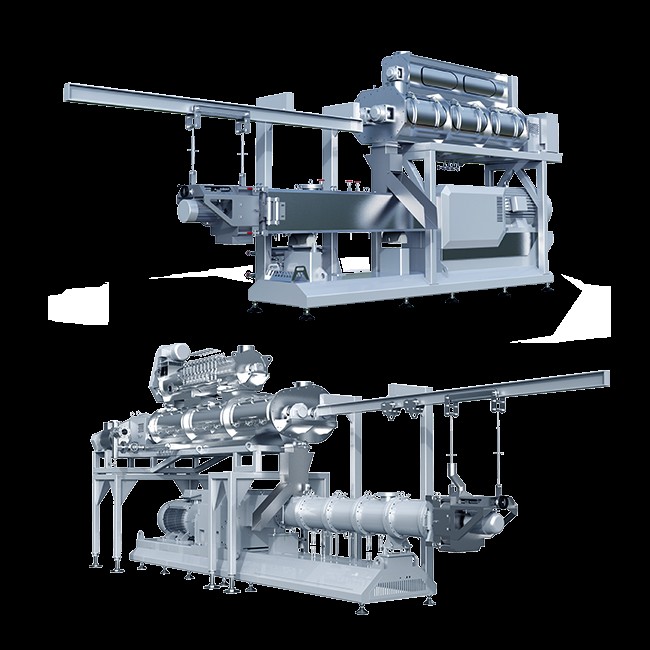
FAMSUN H series aquafeed extruder is designed for several aquafeed formats, including floating feed, sinking feed, slow-sinking feed, and micro aquafeed. Its application range shows why equipment configuration must correspond with formulation characteristics and the physical properties required in the finished product.
Process validation remains essential because nominal equipment capability does not automatically represent actual microbial performance. Temperature profiles, residence time, moisture levels, pressure, feed formulation, and downstream handling can all influence results. Monitoring should consider the complete process rather than focusing on one machine parameter.
Preventing Cross-Contamination Between Batches
Production lines often handle multiple formulations during the same operating period. Ingredient changes can introduce carryover risks when residual powder remains inside conveyors, mixers, bins, or other process components.
Sequence planning can reduce unnecessary exposure between incompatible materials. For example, production schedules may place lower-risk or less problematic formulations before batches containing ingredients that require more stringent handling. Cleaning requirements should be incorporated into the scheduling logic rather than treated as an afterthought.
The feed machine itself should also be assessed for material retention. Discharge geometry, transfer points, internal clearances, and conveying paths can influence how much residual material remains after a batch leaves the system. Routine inspection provides practical evidence about whether the design behaves as expected during actual production.
Designing For Cleaning And Verification
Cleaning procedures work best when equipment geometry supports them. Dry cleaning may be appropriate for many powder-handling areas, while wet cleaning can introduce moisture-related considerations that must be managed carefully. Selecting the method requires consideration of the feed material, equipment construction, sanitation requirements, and drying capability.
Verification should go beyond visual inspection. Swab testing, environmental monitoring, residue checks, and microbiological analysis can provide evidence about whether sanitation practices are functioning as intended. Results can then be used to refine cleaning intervals and identify recurring problem locations.
Maintenance has a similar role. Worn seals, damaged surfaces, loose connections, and poorly functioning discharge components can gradually create hygiene risks. Preventive inspection helps identify such conditions before they become persistent sources of residue or contamination.
Building Safety Into Future Feed Mills
New facilities have an opportunity to incorporate hygiene considerations before equipment is installed. Layout decisions should separate raw-material receiving, processing, finished-feed handling, personnel movement, and waste streams according to the facility’s risk assessment.
Equipment specifications can then reflect those process requirements. Cleanable surfaces, accessible inspection points, controlled material flow, appropriate drainage where relevant, and suitable monitoring locations can all be considered during engineering rather than added after commissioning.
Existing plants face a different challenge because upgrades must work within established buildings and production schedules. Practical improvements may include replacing difficult-to-clean components, modifying transfer points, improving access for inspection, strengthening environmental monitoring, or introducing more structured cleaning verification.
Conclusion
Feed safety incidents have changed the meaning of equipment performance. Capacity and throughput remain important, yet hygiene, accessibility, traceability, and process monitoring increasingly influence engineering decisions. Pathogens such as Salmonella and Listeria require attention to both equipment surfaces and production practices, while mycotoxin control depends heavily on ingredient management and targeted testing.
Modern animal food machine planning benefits from a broader view that connects raw-material control, hygienic design, thermal processing, sanitation, and verification. Thoughtful equipment selection can support this framework without treating machinery as the sole answer to food safety challenges. FAMSUN‘s equipment portfolio, including technologies for different aquafeed formats, shows how process requirements and equipment configuration are considered together as feed safety standards continue to evolve.