
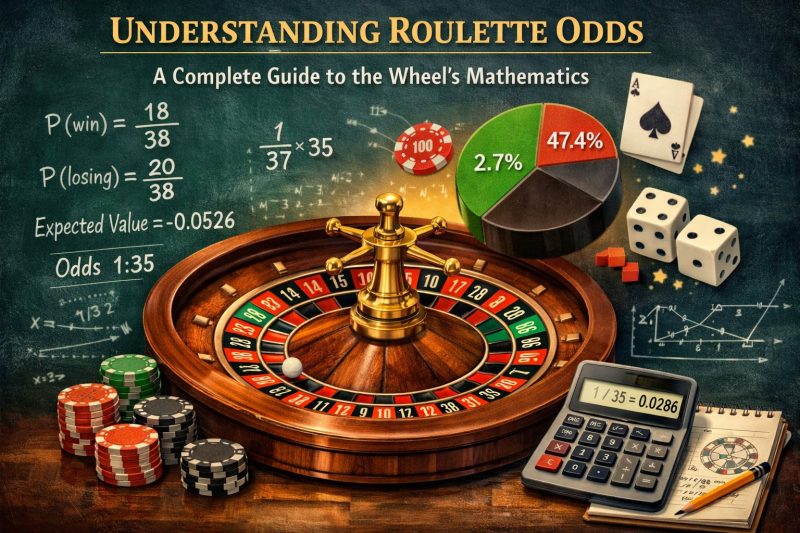

Roulette feels like pure chance, but every bet on the layout has an exact, knowable probability and an exact payout. A roulette odds calculator simply does that arithmetic for you — turning “what are my chances?” into a hard number before you place a chip.
The wheel is just fractions
A single-zero (European) wheel has 37 pockets: numbers 1–36 plus a single green 0. Every outcome is equally likely, so the probability of any event is just favourable pockets ÷ 37.
- A single number (“straight up”): 1/37 = 2.70%, pays 35:1.
- Red or black: 18/37 = 48.6%, pays 1:1.
- A dozen or column (12 numbers): 12/37 = 32.4%, pays 2:1.
- Split (2 numbers): 2/37, pays 17:1.
A calculator takes the bet you describe, counts the winning pockets, and returns both the win probability and the payout — no memorising the table.
Why the payouts never quite match the odds
Here’s the part the calculator quietly exposes. True odds on a single number are 36:1 (36 ways to lose, 1 to win), but the casino pays 35:1. That one-unit gap, spread across 37 outcomes, is the entire house edge: 2.70% on a single-zero wheel. Every bet on the European layout carries that same 2.70% — the calculator shows why no bet is “better” than another in the long run; they all bleed at the same rate.
Betting systems and the calculator’s verdict
Feed a Martingale or a Fibonacci progression into an honest odds calculator and it delivers the bad news: the edge never changes. Because each spin is independent, no sequence of bet sizes alters the 2.70%. What a calculator can do is show your probability of surviving a session — the odds of hitting a losing streak long enough to bust your bankroll — which is far more useful than any “system.”
Provably fair adds one more layer
On a crypto-casino wheel, the outcome isn’t just random — it’s verifiable. The result is generated from a server seed, your client seed and a nonce, hashed together so neither side can tamper with it after the fact. Pair the odds calculator with a provably fair calculator and you can confirm two things at once: that the math of the bet is what you expected, and that the spin that produced it was genuinely fair. That combination — known odds plus verifiable randomness — is the closest a player ever gets to full transparency on a casino game.
Use the calculator before you bet, always choose the single-zero wheel over double-zero (which nearly doubles the edge to 5.26%), and you’ll play roulette with your eyes open.
