
What Are Verbs?
Example:
She runs fast.
They are playing football.
Two Main Types of Verbs
| Verb Type | Purpose | Examples |
|---|---|---|
| Main Verbs | Show the main action or state in a sentence. | eat, run, play, sleep |
| Helping Verbs | Support the main verb to form a verb phrase. | is, am, are, have, will |
What Are Main Verbs?
Examples of Main Verbs:
| Sentence | Main Verb |
|---|---|
| She writes every day. | writes |
| I sleep at 10 PM. | sleep |
| He has eaten dinner. | eaten |
In the first two examples, the main verb stands alone.
In the last example, eaten is the main verb, but it needs a helping verb (has) to complete the sentence.
What Are Helping Verbs?

Examples of Helping Verbs:
| Helping Verb | Used To Show | Examples |
|---|---|---|
| is, am, are | Present Continuous Tense | She is eating. |
| was, were | Past Continuous Tense | He was reading. |
| has, have, had | Perfect Tense | They have gone. |
| will, shall | Future Tense | I will call you later. |
| can, could | Ability or Permission | She can swim. |
| must, should | Advice or Obligation | You should study more. |
In these sentences, the helping verb supports the main verb to express the correct meaning.
Key Difference Between Helping Verbs and Main Verbs
| Feature | Helping Verb | Main Verb |
|---|---|---|
| Shows Action? | ❌ No | ✅ Yes |
| Used Alone? | ❌ Rarely | ✅ Mostly |
| Helps to Show Tense? | ✅ Yes | ❌ No |
| Example | is, am, are, has, have, will | eat, play, go, write, read |
Why Are Helping Verbs and Main Verbs Important?
For example:
She is playing.
(“is” = helping verb, “playing” = main verb)
If you remove “is,” the sentence becomes:
She playing. (Wrong!)
List of Common Helping Verbs
- am
- is
- are
- was
- were
- be
- being
- been
- have
- has
- had
- do
- does
- did
- shall
- will
- should
- would
- can
- could
- may
- might
- must
- ought to
- need
- dare
- used to

Helping verbs List in English
These helping verbs often appear before the main verb in a sentence.
List of Common Main Verbs
- run
- walk
- eat
- drink
- sleep
- write
- read
- speak
- listen
- talk
- sing
- dance
- play
- work
- study
- teach
- learn
- think
- know
- understand
- believe
- remember

Main verbs List in English
Main verbs are responsible for showing the core action in the sentence.
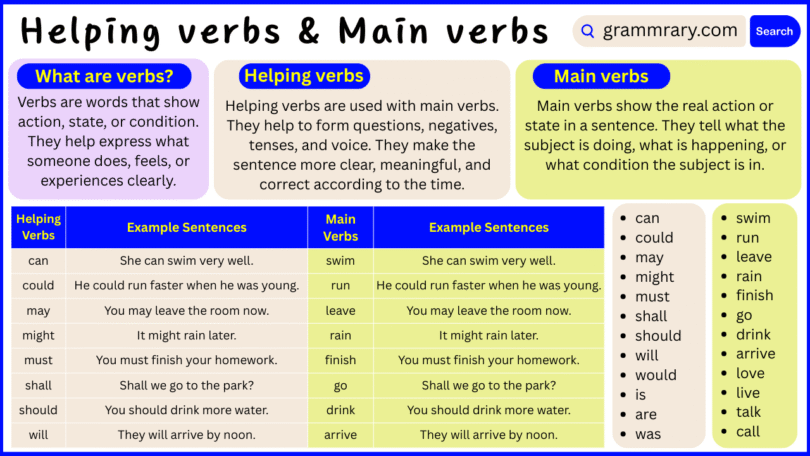
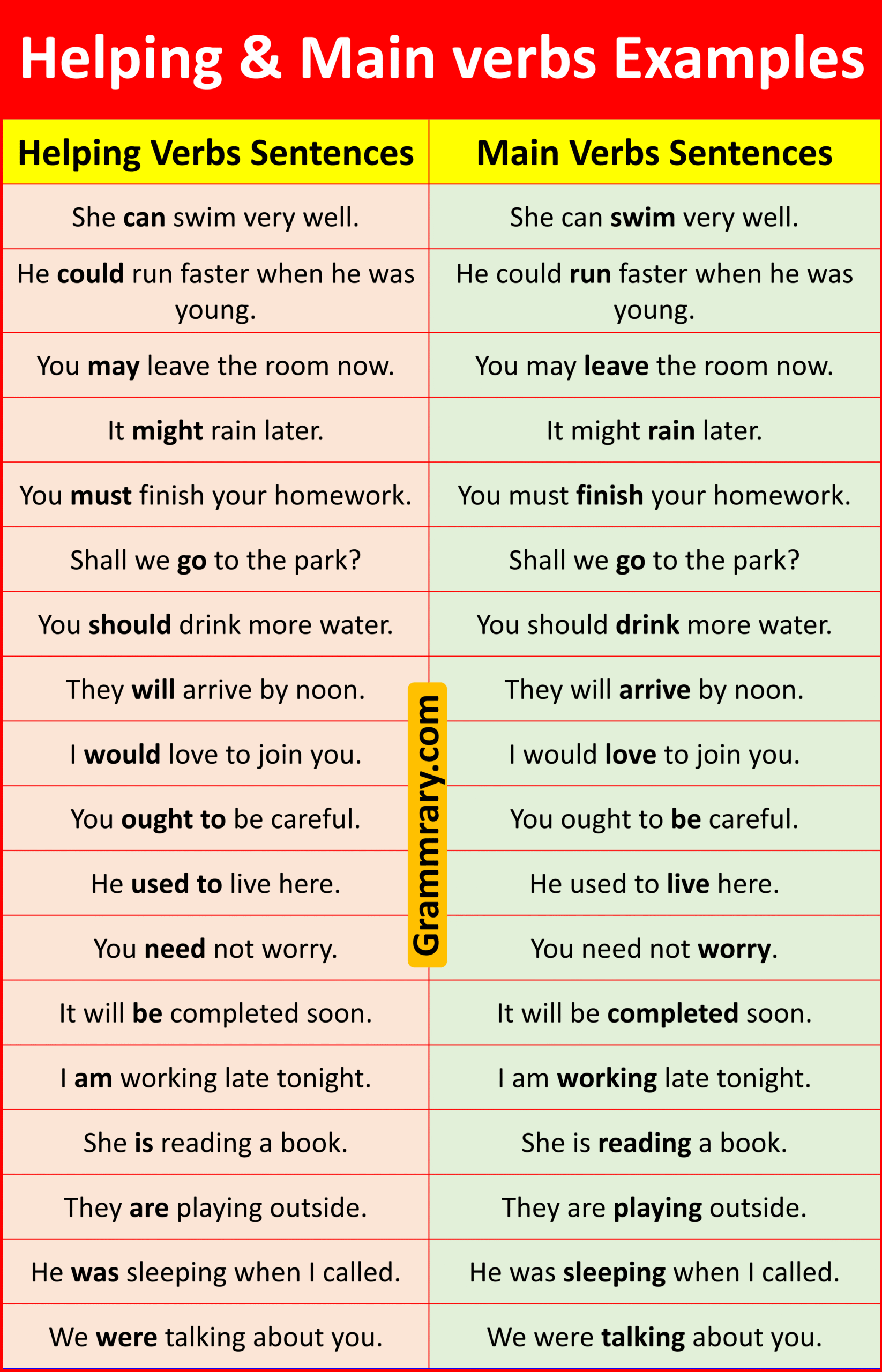
Helping verbs and Main verbs in Sentences
| Helping Verbs Sentences | Main Verbs Sentences |
|---|---|
| She can swim very well. | She can swim very well. |
| He could run fast when he was young. | He could run fast when he was young. |
| You may leave the room now. | You may leave the room now. |
| It might rain later today. | It might rain later today. |
| You must finish your homework. | You must finish your homework. |
| Shall we go to the park? | Shall we go to the park? |
| You should drink more water. | You should drink more water. |
| They will arrive by noon. | They will arrive by noon. |
| I would love to join you. | I would love to join you. |
| You ought to be careful. | You ought to be careful. |
| He used to live here. | He used to live here. |
| You need not worry. | You need not worry. |
| It will be completed soon. | It will be completed soon. |
| I am working late tonight. | I am working late tonight. |
| She is reading a book. | She is reading a book. |
| They are playing outside. | They are playing outside. |
| He was sleeping when I called. | He was sleeping when I called. |
| We were talking about you. | We were talking about you. |
| The project is being reviewed. | The project is being reviewed. |
| She has been waiting for hours. | She has been waiting for hours. |
| Do you like coffee? | Do you like coffee? |
| Does she live here? | Does she live here? |
| Did you call him? | Did you call him? |
| I have completed my work. | I have completed my work. |
| She has a new car. | She has a new car. |
| We had lunch at noon. | We had lunch at noon. |
How to Identify both verbs in a Sentence
Tip 1:
If the verb shows the main action, it is the main verb.
If the verb helps another verb, it is a helping verb.
Tip 2:
Helping verbs usually come before the main verb.
Example:
She has finished her homework.
(has = helping verb, finished = main verb)
Learn more helpful article
- Irregular Plural Noun
- List of all Punctuation Marks
- Articles and its types with Definition
- Personal Pronouns and Possessive Pronouns
- Euphemism, Definition, Types and Examples