

What are Prepositions?
Types of Prepositions
| Type | Usage | Examples | Sentence Example |
|---|---|---|---|
| Prepositions of Place | Show location of an object | in, on, at, under, over, between, behind, beside | The keys are on the table. |
| Prepositions of Time | Indicate time relationships | before, after, during, since, until, by | We will meet after lunch. |
| Prepositions of Direction | Describe movement | to, towards, into, onto, from | She walked towards the school. |
| Prepositions of Manner | Describe how something happens | with, like, by, as, in | She spoke with confidence. |
| Prepositions of Cause, Reason, and Purpose | Show the reason for an action | because of, due to, for, from, out of | He succeeded because of hard work. |
| Prepositions of Possession | Indicate ownership | of, with, to | The book of John is missing. |
| Prepositions of Comparison | Show relationships between two things | like, as, than | She runs like a cheetah. |
| Prepositions of Agency or Instrumentality | Indicate a tool or method | by, with, via | The letter was sent by mail. |
What are Conjunctions?

Difference between Preposition and Conjunction with Examples
Types of Conjunctions
| Type | Usage | Examples | Sentence Example |
| Coordinating Conjunctions | Join two equal parts of a sentence | for, and, nor, but, or, yet, so (FANBOYS) | He was tired, so he went to bed early. |
| Subordinating Conjunctions | Introduce dependent clauses | because, although, since, if, while, unless | She stayed home because she was sick. |
| Correlative Conjunctions | Work in pairs to connect elements | either…or, neither…nor, both…and, not only…but also | Neither John nor Sarah attended the meeting. |
Key Differences Between Prepositions and Conjunctions
| Feature | Preposition | Conjunction |
| Definition | Shows the relationship between a noun/pronoun and other words | Connects words, phrases, or clauses |
| Usage | Used before a noun or pronoun | Used to link sentence elements |
| Types | Prepositions of time, place, direction, etc. | Coordinating, subordinating, correlative |
| Example | The keys are on the table. | She was tired, but she finished her work. |
How to Identify Prepositions and Conjunctions in a Sentence
- Look at the word that follows:
- If it is a noun or pronoun, it is likely a preposition.
- If it connects two clauses or words, it is a conjunction.
- Check its function:
- If it shows position, time, cause, or manner, it is a preposition.
- If it links ideas or choices, it is a conjunction.
Practice Sentences:
Identify whether the bold word is a preposition or a conjunction:
- We arrived after the show started. (Preposition)
- She was sad, but she didn’t cry. (Conjunction)
- He ran towards the finish line. (Preposition)
- I will go if you come with me. (Conjunction)
Differences between Prepositions and Conjunctions in Sentences
| Prepositions (show place, time, direction) | Conjunctions (connect words, phrases, sentences) |
|---|---|
| She sat on the chair. | I will stay because I care. |
| The keys are under the table. | He left early, but she stayed. |
| We walked through the park. | She is tired, so she slept. |
| The book is beside the lamp. | I like tea, and she likes coffee. |
| They arrived before noon. | You can go if you want. |
| I put it inside the box. | She ran fast, yet she lost. |
| She lives near the school. | He studies hard, although it’s tough. |
| The cat is between the chairs. | I will come unless it rains. |
| He parked behind the house. | She smiled while reading. |
| The ball rolled onto the road. | We can eat or watch a movie. |
| He was born in July. | He is slow, but smart. |
| They traveled to Paris. | I will stay until you arrive. |
| She is standing against the wall. | Call me when you reach home. |
| The dog ran toward me. | He left because he was sick. |
| They went along the river. | She works hard, though she is young. |
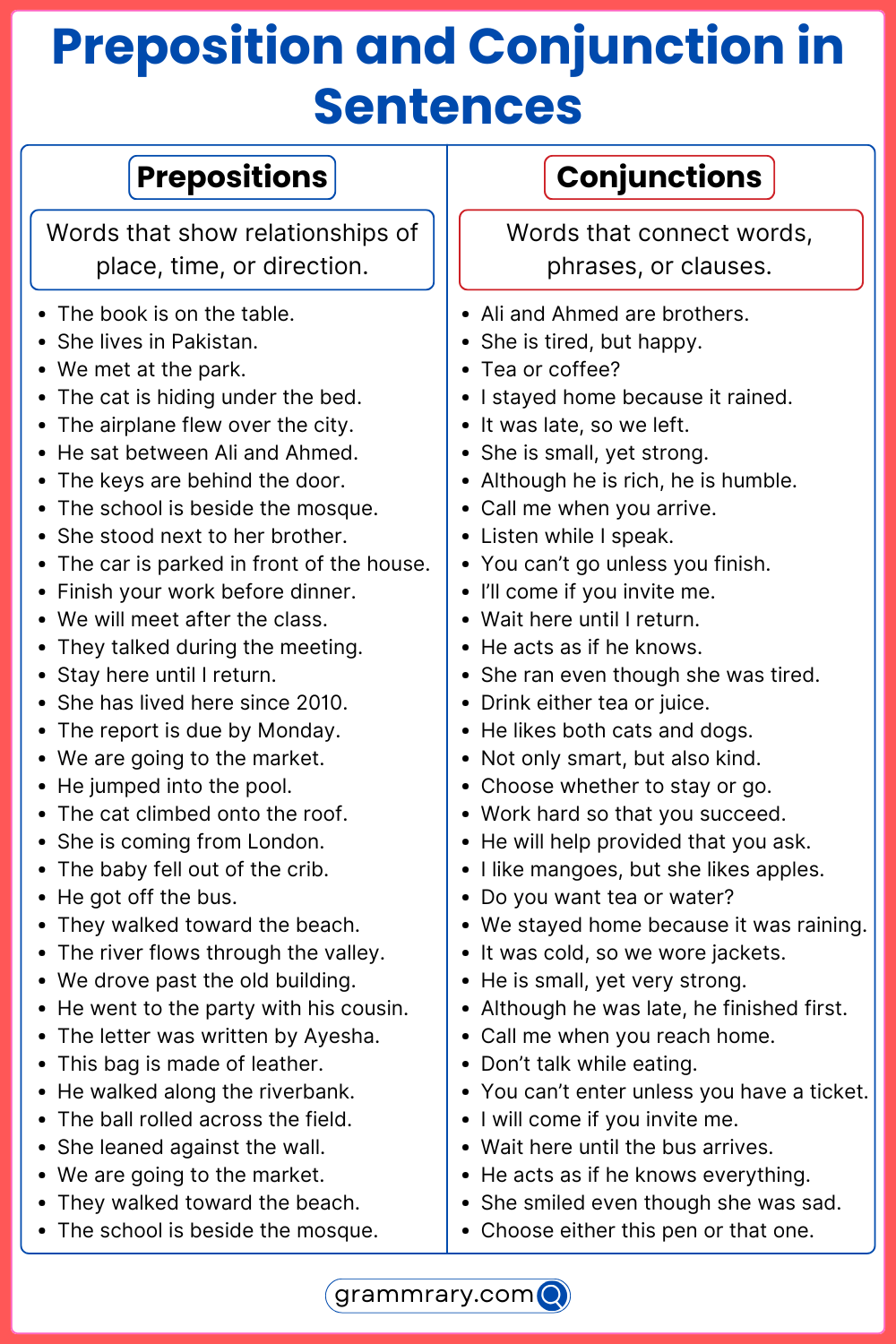
Differences between Preposition and Conjunction in Sentences
Prepositions and Conjunctions lists in English
list of Prepositions in English
- on
- under
- through
- beside
- before
- inside
- near
- between
- behind
- onto
- in
- to
- against
- toward
- along
10 Conjunctions list in English
- because
- but
- so
- and
- if
- yet
- although
- unless
- while
- or
- until
- when
- though

List of Prepositions and Conjunctions
Learn more helpful articles