

Without Naadam, you cannot comprehend the Mongolian culture. It is not a custom only, but the very DNA of the country. Central to them are the Three Games of Courage: wrestling, horse racing, and archery. These happenings have continued throughout centuries as they are constructed differently, rugged, raw, and made by warriors. History has chosen each game, not hype. They were not people of a crowd. They were constructed to survive, honour, and conquer the steppe. It is not nostalgia; it is still the largest sports event in Mongolia nowadays. Curious as to why they are important? Start here.
The Roots of the Naadam Festival
The Three Games date back to the era of Genghis Khan. He used them to prepare his warriors for war—this wasn’t sport, it was survival. Each discipline tested a critical skill needed in battle. Today, competition lives everywhere—even on platforms like the MelBet online betting app—but back then, it was life or death. Wrestling showed raw strength. Horse racing built endurance and control. Archery demanded flawless precision. Combined, they created the ultimate fighter.
When Mongolia became independent in the early 20th century, Naadam was transformed into a public festival. It was institutionalized as a state holiday, and it is still the largest celebration of the year. Thousands of people are crowded in the national stadium of Ulaanbaatar to watch, yet it relates to its nomadic, military origins. There is nothing soft about it.
Why These Three Sports Were Chosen
The Three Games were not selected as entertainment; they had real-life purposes. Both of them tested something that Mongolian society required to exist:
- Wrestling: Power, control, and strength to overcome in a fight.
- Horse racing: The speed, stamina, and ability to navigate in open expanses of land.
- Archery: Accuracy, concentration, and ability to hit at a distance.
These were not mere hobbies but necessities for war, hunting, and protection. The games were not an option, and therefore, they stuck. They possessed the survival skills of the Mongolian steppe. That is the reason they have survived more than 800 years.
Breaking Down the Games Themselves
Wrestling, horse racing, and archery. You have heard the names before. However, the specifics count. The Three Games have a unique format, equipment, and an unwritten code that makes them unique. They are not even new contests applied to ancient traditions. Even these events refer to the severe conditions of the steppe life. To get an idea of why they have existed for centuries, you must see how they are performed nowadays. So, here is what makes each of them special.
Mongolian Wrestling (Bökh)
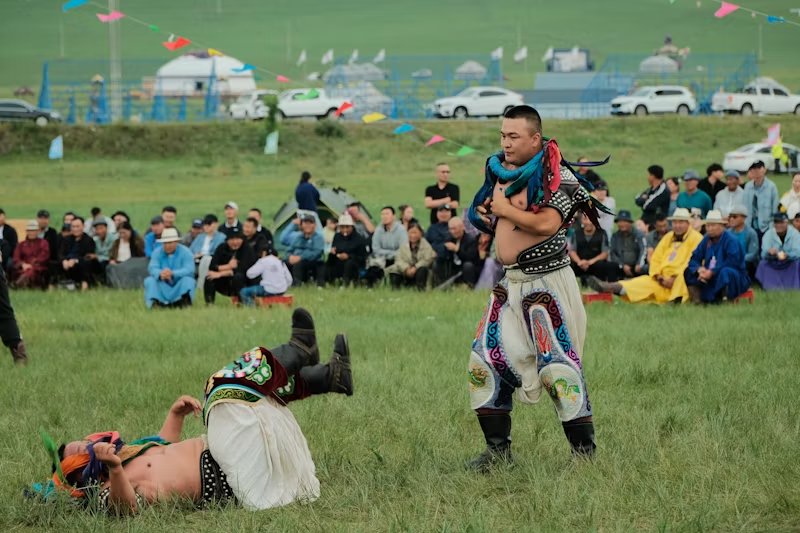
There are no rounds. No time restrictions. No categories of weight. Two men enter the field, and just like on the MelBet Indonesia site, it’s all about skill and outcome—no second chances. The game is over when one of the men falls on the ground. That’s Bökh. The aim is straightforward: to bring any part of the opponent’s body (besides feet) to the ground.
Each step is named, and each victory is respected. Wrestlers are not wearing open-chested jackets and briefs to look good, but to avoid disguise. The eagle-arm entry position is a bit of ritual and intimidation. Bokh is not flamboyant; it is procedural, it is a procedure, it is cruel. It is the most revered of the three games, and it honours its champions like national heroes.
Horse Racing and Archery
Nothing you have ever seen is similar to Mongolian horse racing. The children are riders aged between 5 and 13. The races are long-distance sprints over open country, not a prepared track. It is a competition of the connection between the child and the horse, and not speed.
It is all about control in archery. Traditional composite bows are even competed in by men, women, and even teenagers. Targets are leather rings that are piled up in rows, and distance counts– up to 75 meters. Archers chant when they shoot, and accuracy is not only about hitting the target, but also about how well the arrow is knocked down. Quiet intensity. Accuracy in stress. That is the game.
National Identity Through Competition
Naadam is not only a holiday, but also the way Mongolia reminds itself of what it is. Farmers, urbanites, politicians, and children listen. It is one of the few events that continues to draw the entire country in one direction. The Three Games are not side shows-they are the big stage.
They are the values Mongolians continue to live by: grit, patience, and raw ability. All the wrestlers on the field, all the children on the half-wild horses, all the archers aiming–all these are loaded with history. It is important to win, but it is more important to be present in a prepared way. This is the reason the Games cannot be touched. They interlink the past and the present without the need to clarify it.
Modern Revival and Global Recognition
The Three Games did not die; they grew. Naadam is currently broadcast live, reported by foreign media, and watched by Mongolian diasporas. In 2010, it was designated as Intangible Cultural Heritage by UNESCO, securing its international worth. Nothing changed within Mongolia, however. The very same dirt fields. The same songs. Equal weight behind each game. Tradition was not rebranded; it remained real.
