
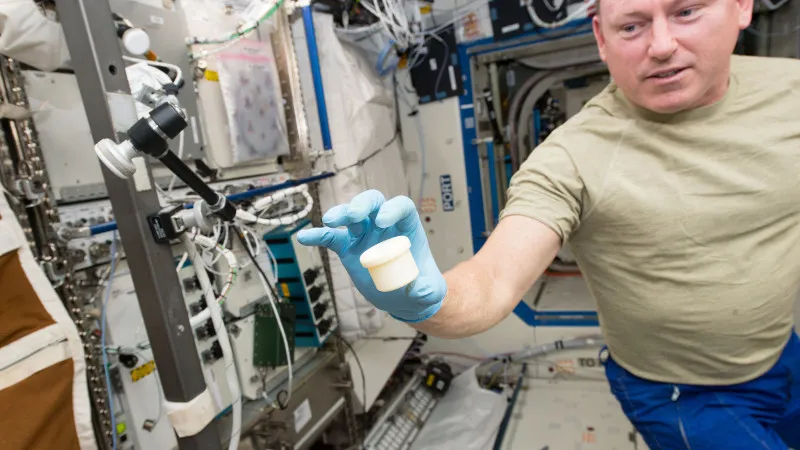

For more than half a century, space exploration has been defined by a fundamental challenge: every single tool, spare part, and piece of equipment needed for a mission had to be designed, built, and tested on Earth, and then launched into space aboard a rocket. This “carry-along” model is incredibly expensive, inefficient, and risky. If a critical part breaks or a new tool is needed, there’s no cosmic hardware store to visit. Astronauts have to make do with what they have.
But now, a transformative technology is poised to rewrite the rules of space logistics: 3D Printing, also known as Additive Manufacturing. By giving astronauts the ability to manufacture items on-demand, in space, 3D printing is not just improving current missions, it’s making entirely new kinds of long-duration exploration, like missions to Mars, not just possible, but plausible.
The Tyranny of the Rocket Equation
The biggest hurdle in space travel is weight. Every kilogram launched into orbit costs thousands of dollars. This reality, governed by the “tyranny of the rocket equation,” forces mission planners to make agonizing decisions about what to pack. Every spare part is a trade-off against more food, water, or scientific equipment.
3D printing shatters this paradigm. Instead of launching a hundred spare parts, a mission can launch a single 3D printer and spools of raw material (like plastic filament or metal powder). This dramatically reduces launch mass and frees up valuable space for other critical supplies.
This shift in thinking, from pre-planned logistics to on-demand manufacturing, is a core concept now being explored in advanced aerospace studies. For students and professionals looking to be part of this new era, many universities now offer space related courses that focus on in-space manufacturing, sustainable mission design, and other pioneering technologies that are defining the future of exploration.
Key Ways 3D Printing is Revolutionizing Space Missions:
1. On-Demand Spare Parts and Tools
- The Problem: A broken component on the International Space Station (ISS) could mean waiting months for a resupply mission.
- The 3D Printing Solution: Astronauts can now print replacement parts themselves. In a famous early example, a custom-designed wrench was emailed to the ISS and printed on the station’s printer, demonstrating the incredible power of digital manufacturing in space. This turns unforeseen problems into solvable challenges.
2. Rapid Prototyping and Innovation in Zero-G
- The Problem: It’s difficult to predict exactly how some tools will perform in microgravity.
- The 3D Printing Solution: Astronauts can now act as their own engineers. They can identify a need, design a new tool, print a prototype, test it, and iterate on the design in a matter of hours. This accelerates innovation and allows for the creation of tools perfectly adapted to the space environment.
3. Building Structures in Space and on Other Worlds
- The Problem: Launching large, pre-fabricated habitats or structures is incredibly complex and expensive.
- The 3D Printing Solution: This is where the technology becomes truly game-changing. Future missions envision using large-scale 3D printers to construct habitats on the Moon or Mars using local materials, a concept known as In-Situ Resource Utilization (ISRU). By using lunar or Martian regolith (soil) as the printing material, we can build landing pads, radiation shields, and even entire habitats without having to launch them from Earth.
4. Customized Medical and Scientific Equipment
- The Problem: Every astronaut is different, and medical needs can be unpredictable.
- The 3D Printing Solution: In the future, 3D printing could be used to create custom-fit medical devices, like splints or surgical guides, tailored to an astronaut’s specific anatomy. It could also be used to print scientific equipment on the fly, allowing for more flexible and responsive research in space.
The Science Behind the Innovation
The application of 3D printing in space is a fascinating intersection of materials science, robotics, and astrophysics. Understanding how different materials behave when printed in a vacuum or in microgravity is a major area of research. This requires a deep, foundational knowledge of the physical sciences. For those aspiring to contribute to this research, pursuing space science courses that cover topics like planetary geology, materials science, and remote sensing is essential. These programs provide the scientific understanding needed to tackle challenges like identifying the best regolith for construction or developing new printing materials for the harsh environment of space.
Conclusion: A New Era of Self-Sufficiency
3D printing is fundamentally changing our relationship with space exploration. It’s moving us away from a complete reliance on Earth and towards a future of greater self-sufficiency and adaptability. By giving us the ability to build what we need, where we need it, this technology is not just a convenience – it’s a critical enabler for the next giant leap in our journey to the stars. The future of space travel won’t just be launched; it will be printed.